
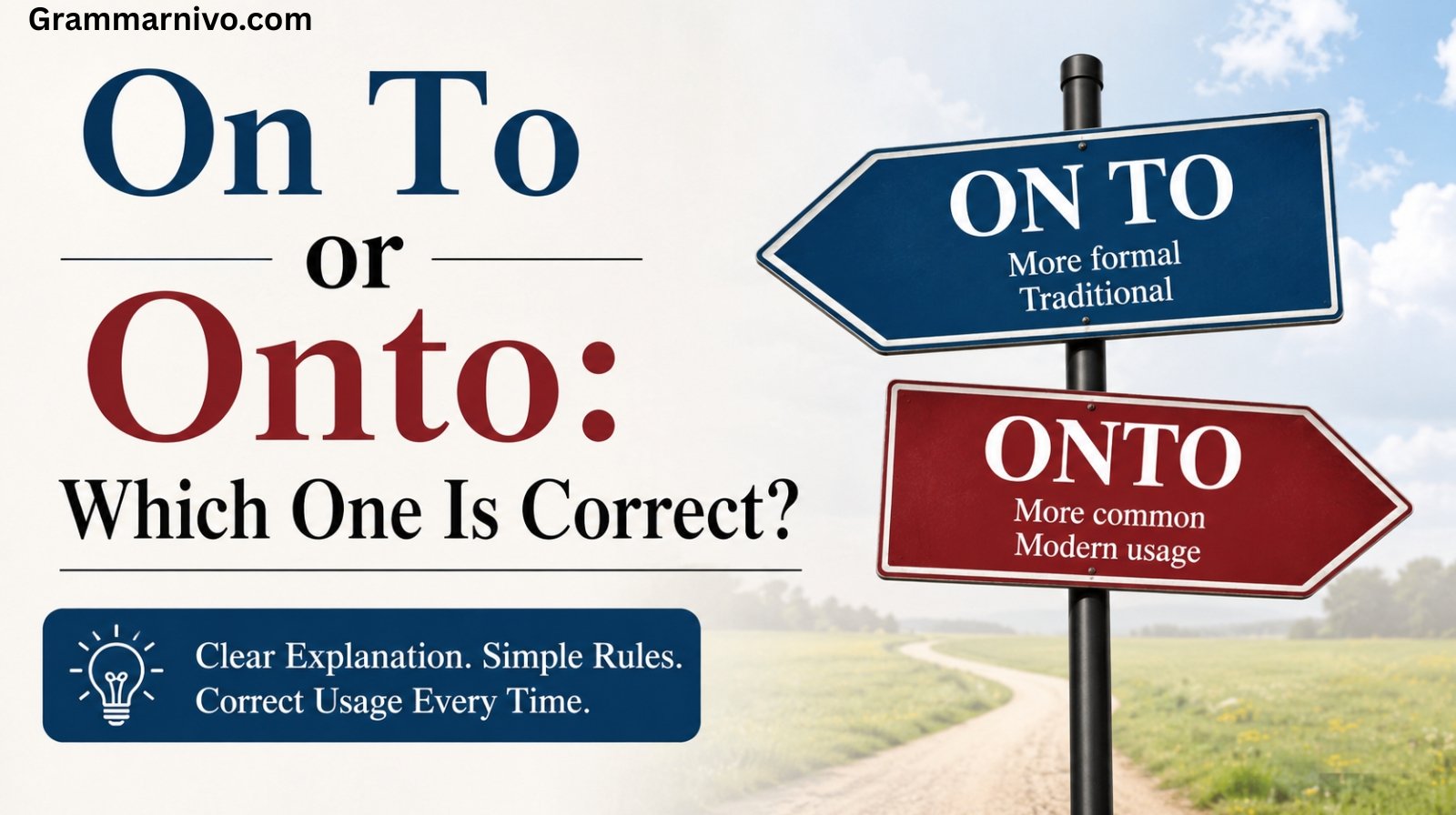
If you are unsure whether to write on to or onto, you are not alone. These two forms sound almost identical, but they do not always have the same grammatical function. So, on to or onto which one is correct? The answer depends on what you mean and how the words function in your sentence.
In general, onto is used as a single preposition to show movement to a position on something, while on to is usually written as two words when on belongs to a verb or phrase and to introduces what comes next.
For example:
- The cat jumped onto the table.
- We moved on to the next topic.
The good news is that once you understand the basic difference, choosing the correct form becomes much easier.
On To or Onto: What Is the Difference?
The main difference between onto and on to is grammatical function.
Onto is normally one preposition. It commonly describes movement toward a position on a surface, object, or place.
On to contains two separate words. In many cases, on belongs to the verb or acts as an adverb, while to introduces another destination, person, topic, or action.
What Does “Onto” Mean?
Onto generally means moving to a position on something.
For example:
- The boy climbed onto the roof.
- The dog jumped onto the sofa.
- She stepped onto the platform.
- He placed the books onto the desk.
- The ball rolled onto the road.
A useful way to think about it is:
Onto = movement to a position on something.
The word can also have figurative meanings. For example:
- I think we’re onto something.
- The police are onto him.
- She is onto a good idea.
Here, onto does not necessarily describe physical movement. It can indicate awareness, discovery, or being close to understanding something.
What Does “On To” Mean?
On to is written as two words when on and to perform separate grammatical jobs.
This commonly happens when on is part of a phrasal verb:
- Move on to the next question.
- She went on to explain the problem.
- He passed the message on to his manager.
- Let’s go on to the next chapter.
- Hold on to your ticket.
For example, in:
We moved on to the next topic.
The phrase move on means to continue or progress. The word to then introduces the next topic.
That is why on to is the clearer choice in this sentence.
When Should You Use Onto?
The easiest way to use onto correctly is to look for movement or placement toward a surface or position.
Use “Onto” for Physical Movement
When something moves from one position to another and ends up on a surface, onto is usually the natural choice.
Examples:
- The cat jumped onto the bed.
- The child climbed onto the chair.
- She stepped onto the stage.
- The bird flew onto the roof.
- The man jumped onto the bus.
Compare these with sentences using on:
The cat is on the bed.
This sentence describes location.
The cat jumped onto the bed.
This sentence describes movement toward that location.
So a simple pattern is:
on = position
onto = movement toward a position
Use “Onto” for Placement
Onto can also describe something being placed or transferred to a surface.
Examples:
- She poured the water onto the floor.
- Put the documents onto the desk.
- He transferred the files onto the new computer.
- The child threw the toy onto the bed.
The important idea is that something ends up on another thing.
Use “Onto” in Certain Figurative Expressions
Onto also appears in expressions where the meaning is not physical.
For example:
I think we’re onto something.
This means you may have discovered a useful idea or important possibility.
Another example:
The detective is onto the suspect.
This means the detective has discovered or suspects something about the person.
These established expressions use onto as one word.
When Should You Use On To?
Use on to when on belongs to the preceding verb or expression and to introduces what comes next.
Use “On To” for Continuing or Progressing
This is one of the most common situations.
Examples:
- Let’s move on to the next lesson.
- She went on to become a successful writer.
- After dinner, we moved on to another subject.
- He went on to explain the results.
- The teacher moved on to the final question.
Here, the meaning is not “move onto a surface.”
Instead, it means continue, progress, or move to another stage or subject.
For example:
Let’s move on to the next question.
The phrase move on means “continue.” The word to introduces the next question.
Use “On To” After Phrasal Verbs
Phrasal verbs are a major reason people confuse these forms.
Consider:
- hold on to
- hang on to
- pass on to
- move on to
- go on to
- log on to
Examples:
Please hold on to your receipt.
She passed the information on to her manager.
We should move on to the next section.
He went on to study medicine.
In these examples, keeping on and to separate helps preserve the structure of the phrase.
Use “On To” When “To” Introduces Another Action
Sometimes to introduces an infinitive rather than a physical destination.
For example:
She went on to explain the situation.
Here, went on means continued, while to explain introduces the next action.
Similarly:
He read on to discover the answer.
The important point is that on is doing its own grammatical job.
On To vs. Onto: Quick Comparison
| Situation | Correct Form | Example |
|---|---|---|
| Movement to a surface | onto | The cat jumped onto the table. |
| Stepping onto a place | onto | She stepped onto the stage. |
| Placing something on a surface | onto | He put the book onto the desk. |
| Continuing to another topic | on to | Let’s move on to the next topic. |
| Continuing to another action | on to | She went on to explain the problem. |
| Passing something to someone | on to | Pass the message on to John. |
| Holding something | on to | Hold on to the railing. |
| Being aware of something | onto | I think we’re onto something. |
The table is a useful shortcut, but always consider the complete meaning of the sentence.
A Simple Test for Choosing On To or Onto
If you regularly confuse these words, try this three-step test.
Step 1: Ask What “On” Is Doing
Look at the sentence and ask:
Is “on” part of the verb or phrase?
If yes, you probably need on to.
For example:
We moved on to the next chapter.
The phrase is move on, so keep on separate from to.
Step 2: Ask Whether Something Moves Onto a Surface
If the sentence describes movement toward a position on something, onto is usually correct.
For example:
The cat jumped onto the sofa.
The cat moves to a position on the sofa.
Step 3: Try Replacing “Onto” With “On”
This can be a helpful editing trick.
She placed the bag onto the table.
You can say:
She placed the bag on the table.
The basic meaning remains clear.
Now consider:
We moved on to the next lesson.
Replacing on to with simply on changes the sentence:
We moved on.
The phrase is complete, but it no longer tells us what came next.
That difference can help you recognize when on to should remain separate.
Common Examples of On To and Onto
Seeing the forms side by side makes the difference easier to remember.
Physical Movement
Onto:
The child climbed onto the bed.
The bird landed onto the roof.
She stepped onto the platform.
The ball rolled onto the road.
Progression
On to:
Let’s move on to the next topic.
She went on to become a doctor.
We can move on to the next step.
He went on to discuss the main problem.
Holding Something
On to:
Hold on to the railing.
She held on to her mother’s hand.
Don’t let go; hold on to the rope.
Passing Something
On to:
Please pass the message on to Sarah.
He handed the responsibility on to another employee.
Being Aware
Onto:
The investigators are onto the truth.
I think we’re onto something.
She knew her friends were onto her plan.
A Real-Life Example: Why the Space Matters
Imagine a teacher is giving a lesson to a group of students.
She begins by explaining fractions. After several minutes, she says:
“Now let’s move on to decimals.”
Here, on to is correct because the teacher is continuing from one subject to another. She is not physically moving onto a surface. The phrase move on means to continue.
Now imagine the same teacher is walking onto a stage before starting the lesson:
“The teacher stepped onto the stage and greeted the students.”
This time, onto is correct because the teacher physically moves to a position on the stage.
Now consider a third situation. A student is holding a railing while walking upstairs:
“The student held on to the railing.”
Here, hold on is the important phrase. The student is maintaining a grip, and to introduces the object being held.
These examples show why simply memorizing “onto means movement” is not enough. Context matters. The same sound can represent different grammatical structures.
The best approach is to ask what the sentence actually means. Is someone or something moving to a surface? Use onto. Is someone continuing, progressing, holding, passing, or performing another action involving a phrasal verb? On to may be the better choice.
2026 Usage Data Snapshot
There is no single reliable public statistic that can tell us how many people make the on to vs. onto mistake. Search-engine interest also cannot determine grammatical correctness. Therefore, it would be misleading to invent a search-volume percentage or claim that one form is “more correct” simply because it appears more often online.
However, current dictionary data gives us a useful picture of how the word onto functions in modern English.
Cambridge currently lists onto as a preposition and identifies several established uses, including movement, changing subjects, holding, awareness, asking/contacting, and adding or joining. Its movement sense is marked B1, while some other uses are marked at higher levels.
This tells us something important: onto is not limited to physical movement. Modern English uses it in several established expressions.
Current grammar guidance also distinguishes onto from on to according to grammatical function. Cambridge explains that onto commonly expresses movement to a position on a surface, while on to can occur when the two words perform separate functions.
So, rather than relying on an unsupported “X% of writers use this form” statistic, the most trustworthy 2026 takeaway is:
- Onto is an established English preposition.
- On to remains necessary when the two words have separate grammatical roles.
- Both forms can be correct depending on context.
- Dictionary and grammar evidence supports a meaning-based approach rather than a frequency-only approach.
British English vs. American English
The basic distinction between onto and on to works similarly in British and American English.
For example, both varieties commonly use:
The cat jumped onto the table.
And both commonly use:
Let’s move on to the next question.
There can be variation in borderline constructions. Some style preferences may favor on to where others accept or prefer onto.
For example:
She climbed onto the roof.
and:
She climbed on to the roof.
can both be encountered when the intended meaning is physical movement to the roof.
However, the distinction becomes much stronger when on is clearly part of a phrasal verb:
She went on to explain the problem.
That structure should not automatically be changed to onto.
The important lesson is that the difference is primarily grammatical rather than simply British versus American spelling.
Common Mistakes With On To and Onto
Mistake 1: Using “onto” Everywhere
Some writers assume that because onto exists as one word, it can replace every instance of on to.
That is not correct.
For example:
Let’s move on to the next section.
is the clearer construction because move on means continue.
Mistake 2: Separating “onto” When It Functions as One Preposition
Consider:
The dog jumped onto the sofa.
Here, onto directly describes the dog’s movement to the sofa.
Mistake 3: Ignoring Phrasal Verbs
Always check whether on belongs to the verb.
Examples include:
- move on
- go on
- hold on
- pass on
- hang on
- log on
When to follows these constructions, the two words often remain separate.
Mistake 4: Choosing Based Only on Sound
In speech, onto and on to can sound almost identical.
That means pronunciation alone cannot always tell you which form to write.
Instead, look at the grammar and meaning.
Mistake 5: Assuming Both Forms Always Mean the Same Thing
They do not.
Compare:
The detective is onto the suspect.
with:
The detective moved on to another case.
The first means the detective has become aware or suspicious. The second describes progression to something else.
Quick Checklist: Which Form Should You Use?
Before publishing an article, email, essay, or social media post, ask:
- Is something moving to a position on a surface? → onto
- Is something being placed on a surface? → onto
- Does on belong to a phrasal verb? → Usually on to
- Does the sentence mean “continue to the next thing”? → on to
- Does to introduce another action? → Usually on to
- Does onto mean “aware of” or “onto something”? → onto
- Could either form work because the sentence describes physical movement? → Check your preferred style guide and choose the clearest version.
Mini Quiz: On To or Onto
1. Fill in the Blank
The cat jumped ___ the kitchen table.
Answer: onto
2. Pick the Correct One
Which sentence is correct?
A) Let’s move onto the next topic.
B) Let’s move on to the next topic.
Answer: B) Let’s move on to the next topic.
3. Fill in the Blank
She stepped ___ the stage and smiled at the audience.
Answer: onto
4. Quick Grammar Check
Choose the correct phrase:
Hold ___ your ticket.
A) onto
B) on to
Answer: B) on to
5. Which Sounds Right?
We went ___ discuss the problem in more detail.
A) onto
B) on to
Answer: B) on to
6. Fill in the Blank
The dog jumped ___ the sofa.
Answer: onto
7. Spot the Correct Sentence
A) He went onto become a famous writer.
B) He went on to become a famous writer.
Answer: B) He went on to become a famous writer.
8. Surface or Progress?
Which word fits?
The ball rolled ___ the road.
Answer: onto
9. Fill in the Blank
After explaining grammar, the teacher moved ___ spelling.
Answer: on to
10. Choose the Best Option
The detective thinks she is ___ something important.
A) on to
B) onto
Answer: B) onto
11. Can You Catch the Mistake?
Is this sentence correct?
“Let’s move onto the next question.”
Answer: Not the clearest choice. When you mean “continue to the next question,” move on to is better.
12. Fill in the Blank
Please pass this message ___ your manager.
Answer: on to
13. One-Second Challenge
Which sentence shows physical movement?
A) We moved on to another subject.
B) The child climbed onto the chair.
Answer: B) The child climbed onto the chair.
14. Final Challenge 🎯
Choose the correct sentence:
A) The bird landed on to the roof.
B) The bird landed onto the roof.
Answer: B) The bird landed onto the roof.
Quick takeaway:
👉 Onto = movement/position on something
👉 On to = continuing or moving forward to something else
Frequently Asked Questions
Is “on to” or “onto” correct?
Both are correct, but they are used differently. Onto commonly functions as a preposition showing movement to a position on something. On to is used when on and to have separate grammatical functions.
What is the easiest way to remember onto vs. on to?
Think of onto for movement or placement on something:
The cat jumped onto the table.
Think of on to for continuation:
Let’s move on to the next topic.
This is not a perfect rule for every possible sentence, but it works for many common situations.
Is it “move onto” or “move on to”?
It depends on the meaning.
Use move onto when describing physical movement to a surface or place:
The workers moved onto the platform.
Use move on to when meaning “continue to another subject or stage”:
The teacher moved on to the next topic.
Is it “hold onto” or “hold on to”?
Hold on to is a very common traditional form:
Hold on to your ticket.
Hold onto is also widely used, especially in modern informal English. The choice can depend on context and style.
Is it “log onto” or “log on to”?
Both forms are found in modern English.
Log on to your account.
Log onto your account.
The two forms can have the same practical meaning in this context because log on is an established phrasal verb and modern usage sometimes combines the words.
Should I write “move onto the next topic” or “move on to the next topic”?
When you mean continue to the next topic, move on to is the clearest choice:
Let’s move on to the next topic.
Using onto can suggest physical movement to a surface or location, although modern usage sometimes allows overlap in certain contexts.
Can “onto” and “on to” both be correct?
Yes. In some sentences describing physical movement, both forms may be found:
The cat climbed onto the roof.
The cat climbed on to the roof.
However, they are not interchangeable in every sentence. When on belongs to a phrasal verb and to introduces what follows, keeping the words separate is often important.
Conclusion
So, on to or onto which one is correct? The answer depends on the role the words play in your sentence.
Use onto when it functions as a single preposition, especially for movement or placement to a position on something:
The dog jumped onto the sofa.
Use on to when on belongs to the preceding verb or phrase and to introduces what comes next:
Let’s move on to the next lesson.
The easiest strategy is to focus on meaning and grammar instead of sound. If something moves onto a surface, onto is usually right. If someone continues, progresses, passes, holds, or goes on to something else, on to is often the better choice.
Once you start checking what on is doing in the sentence, the difference becomes much easier to recognize.
Save this guide for the next time you are unsure, and check GrammarNivo for more clear explanations of confusing English words and grammar rules.
Keep learning with more easy grammar lessons on Grammarnivo.
Authoritative References

I’m Bilal Khalid, the author behind GrammarNivo. I enjoy exploring English grammar, common mistakes, confusing words, and everyday language usage. Through my writing, I try to explain grammar in a simple and practical way, so readers can understand the rules easily, improve their writing, and feel more confident using English.