If you have ever wondered whether “foody” or “foodie” is the correct spelling, you are not alone. Both words sound exactly the same, which makes the choice confusing when writing a blog post, social media caption, restaurant review, or everyday message.
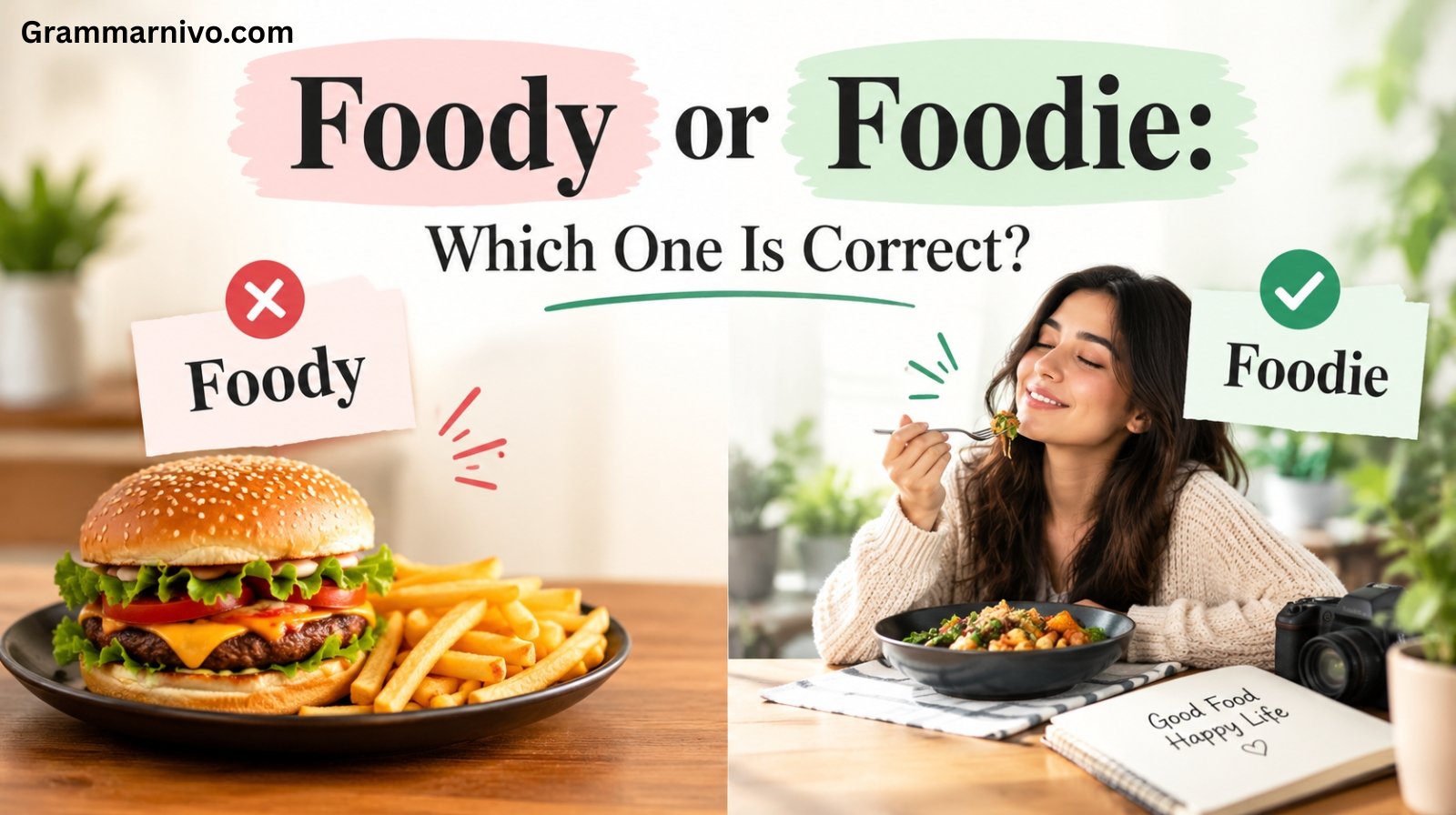
The good news is simple: foodie is the preferred spelling when you mean a person who loves food, cooking, restaurants, and trying different cuisines. However, “foody” is not completely imaginary it is recognized by major dictionaries as an alternative spelling of “foodie.”
In this guide, you will learn the difference between foody and foodie, what each word means, how to use them correctly, and which spelling is best for everyday and professional writing.
Foody or Foodie: Which Spelling Is Correct?
The short answer
Foodie is the spelling you should normally choose.
A foodie is a person who has a strong interest in food, especially cooking, eating, discovering new dishes, and exploring different cuisines. Both Cambridge and Oxford list foodie as an established English word.
For example:
- Correct and preferred: She is a real foodie.
- Also recognized: She is a real foody.
- Best choice for most writing: She is a real foodie.
The important detail is that foody can also be found in dictionaries as an alternative form, so simply calling it an impossible or nonexistent word would be inaccurate. Cambridge specifically identifies foody as “another spelling of foodie.”
Why “foodie” is the safer choice
Although both forms can refer to a food enthusiast, foodie is much more familiar to modern English readers.
If you are writing:
- a school assignment
- a website article
- a restaurant review
- a travel guide
- a social media post
- a professional email
- a food blog
foodie is the clearest choice.
Quick comparison
| Word | Meaning | Status | Best choice? |
|---|---|---|---|
| Foodie | A person enthusiastic about food | Established and widely recognized | ✅ Yes |
| Foody | Alternative spelling of foodie | Recognized by dictionaries | ⚠️ Less common |
So, if someone asks, “Foody or foodie which one should I use?”, the practical answer is: Use foodie.
What Does “Foodie” Mean?
Foodie as a noun
The most common use of foodie is as a noun.
It describes someone who is particularly interested in food, cooking, eating, restaurants, or discovering different cuisines. Oxford defines foodie as a person who is very interested in cooking and eating different kinds of food.
For example:
My brother is a foodie who loves trying new restaurants.
Here, foodie describes a person whose interest in food goes beyond simply eating because they are hungry.
Other examples include:
- Maria is a foodie who loves Italian cuisine.
- Every foodie should try this restaurant.
- He became a foodie after learning how to cook.
- My friend is a huge foodie and enjoys exploring local dishes.
Foodie as an adjective
Foodie can also be used to describe something connected with food enthusiasts.
For example:
- This is a great foodie destination.
- We planned a foodie trip around the city.
- She writes for a popular foodie website.
Cambridge also records foodie as an adjective, as well as foody as an alternative form.
What is the plural of foodie?
The plural form is:
foodie → foodies
Examples:
- One foodie
- Two foodies
- Many foodies
For example:
The restaurant is popular with local foodies.
Notice that the -ie changes to -ies in the plural.
What Does “Foody” Mean?
Foody as an alternative spelling
When foody refers to a person who loves food, it can be used as an alternative spelling of foodie.
This is an important distinction because many online explanations incorrectly say that foody is always wrong. Major dictionary sources provide evidence that the spelling exists.
Cambridge lists foody as another spelling of foodie, while Collins also gives foodie and foody as forms referring to someone with an enthusiastic interest in food.
So these can communicate essentially the same idea:
She is a foodie.
She is a foody.
However, the first sentence is generally the better choice for broad modern English writing.
Why does “foody” look so natural?
The spelling foody seems logical because English frequently creates adjectives by adding -y to a noun.
For example:
- cloud → cloudy
- rain → rainy
- dirt → dirty
- taste → tasty
Because of this pattern, someone may naturally think:
food + y = foody
But foodie developed as the established noun for a person with a strong interest in food. Collins traces foodie to food + -ie, possibly influenced in part by words such as junkie.
That is why spelling based purely on how a word “looks” can sometimes lead you to the less familiar form.
Does “foody” have other meanings?
Yes. Foody can have adjective uses in English beyond the noun meaning “foodie.” Historical and dictionary sources record meanings connected with being edible, food-bearing, or related to food.
Therefore, context matters.
If you are talking about a person who loves food, however, foodie is the best default spelling.
Foodie vs. Foody: Examples in Sentences
Examples with “foodie”
Here are some natural examples:
- I am a foodie who loves trying new cuisines.
- Sarah considers herself a foodie.
- The city is a perfect destination for foodies.
- He follows several foodie accounts online.
- My sister became a foodie after traveling abroad.
- This restaurant is popular with young foodies.
Examples with “foody”
Because foody is recognized as an alternative spelling, you may encounter sentences such as:
- She describes herself as a foody.
- He is a foody who enjoys experimenting with recipes.
However, if you are creating new content, foodie will usually be the more recognizable option.
A simple comparison
| Sentence | Recommendation |
|---|---|
| I am a foodie. | ✅ Preferred |
| I am a foody. | ⚠️ Recognized alternative |
| She loves trying new food, so she is a foodie. | ✅ Preferred |
| She loves trying new food, so she is a foody. | ⚠️ Alternative |
The difference is therefore mainly about spelling preference and familiarity, rather than a completely different meaning.
Why Do People Confuse “Foody” and “Foodie”?
They sound the same
One of the biggest reasons for the confusion is pronunciation.
Both foodie and foody are generally pronounced like:
FOO-dee
Cambridge gives the pronunciation of foodie as /ˈfuː.di/ in both UK and US English.
When people hear the word rather than see it written, they cannot tell which spelling is being used.
“Food + y” looks logical
Another reason is that foody appears to follow a familiar English spelling pattern.
Someone may hear:
food + ee
and naturally write:
foody
But established English vocabulary does not always follow the spelling pattern that seems most logical.
People encounter both forms online
Search engines, social media, restaurant websites, usernames, and informal writing can expose readers to both spellings. This can make it difficult to determine whether one is an error or an accepted variant.
Dictionary evidence helps resolve that confusion: foodie is the established preferred form, while foody is also recorded as an alternative.
Foodie or Foody: Which One Should You Use?
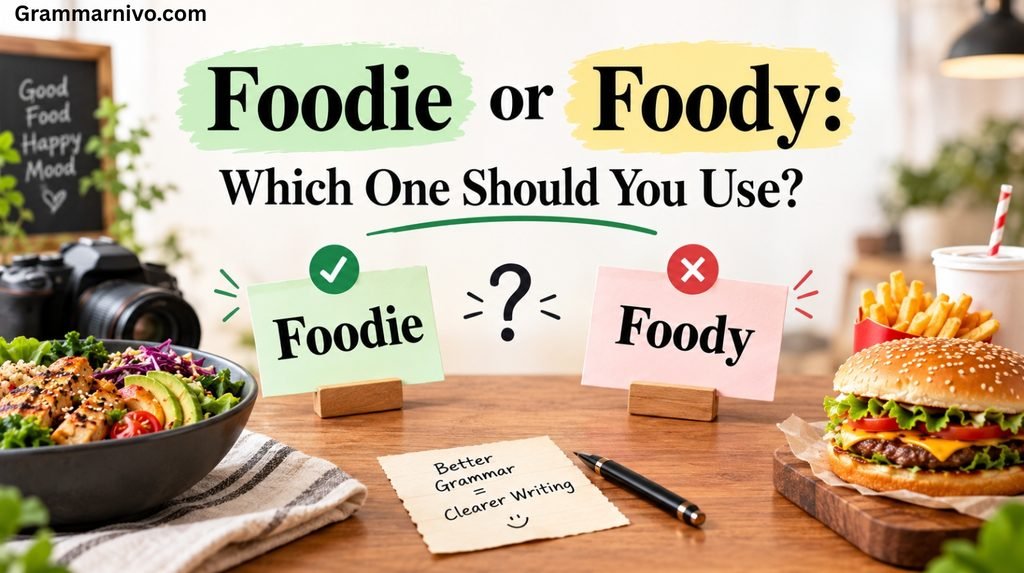
Use “foodie” for general writing
If you are unsure, choose foodie.
It is especially suitable for:
- Articles
- Blog posts
- Restaurant reviews
- Travel writing
- Social media
- School assignments
- Marketing copy
- Everyday conversations
For example:
Correct choice: This guide is perfect for foodies who love discovering new restaurants.
This version is immediately familiar to most readers.
When might “foody” appear?
You may encounter foody in:
- Informal writing
- Alternative spelling
- Usernames or brand names
- Quoted material
- Regional or individual usage
If you are editing someone else’s writing, it is therefore better to understand the context before automatically labeling foody as an outright spelling error.
The easiest rule to remember
Use this simple rule:
Foodie = preferred spelling for a person who loves food.
If you remember only one thing from this article, remember foodie.
What Recent Data Says About Foodie Culture
The word foodie is not just a dictionary term it represents a widely studied consumer and cultural group.
A 2025 research article in the British Food Journal examined foodies using a nationwide U.S. consumer survey. Among the 1,117 respondents who were familiar with the term “foodie,” 38.2% identified themselves as foodies. The study also found that self-identified foodies reported spending more on food at home and restaurants than non-foodies.
More recent 2026 industry research from Bidfood, developed with NIQ and based on insights from more than 2,000 UK out-of-home consumers, reported that 54% of consumers described themselves as foodies. The same research found that 46% wanted to try the latest food trends.
These figures do not determine which spelling is correct. Instead, they show that the concept represented by foodie is well established in modern food culture.
Key takeaway from the data
The terminology is widely used in research and industry discussions, which makes choosing the familiar spelling even more useful when writing for a broad audience.
A Real-Life Example: Choosing “Foodie” for Clear Communication
Imagine that you are creating a travel website about restaurants and local cuisine. You want to publish a headline that attracts readers interested in discovering great places to eat.
You have two possible headlines:
“10 Best Restaurants Every Foody Should Try”
or
“10 Best Restaurants Every Foodie Should Try”
Both may be understood, but the second headline is the stronger choice for general readers because foodie is the more familiar form.
Now imagine that the article includes a sentence such as:
“If you are a foodie, you will love exploring the city’s street-food markets.”
The reader immediately understands that the article is aimed at someone who enjoys food experiences.
Suppose instead that the website consistently uses foody. Some readers may recognize it, while others may pause and wonder whether it is a spelling mistake. That moment of uncertainty is unnecessary.
This illustrates an important writing principle: when two forms communicate the same idea, the more familiar form is often the better choice for clarity. Dictionary evidence supports foody as an alternative, but Cambridge and Oxford both clearly establish foodie as the main dictionary entry.
Therefore, a restaurant blogger, student, marketer, or website owner will generally benefit from choosing foodie.
Quick Checklist: Foody or Foodie?
Use this checklist whenever you are unsure.
Step-by-step spelling guide
Step 1: Ask what you mean.
Are you describing a person who loves or is highly interested in food?
Step 2: Choose the familiar form.
Write foodie.
Step 3: Check the sentence.
For example:
She is a foodie who loves Italian cuisine.
Step 4: Use the plural correctly.
Write:
The restaurant attracts many foodies.
Step 5: Remember the exception.
Foody is recognized as an alternative spelling, so it is not accurate to say that the form can never exist. However, foodie remains the better default choice for general writing.
Quick memory trick
Think:
Food + ie = Foodie
If you mean a person who loves food, reach for foodie first.
Mini Quiz: Foody or Foodie
1. Foodie or Foody?
Which spelling is the preferred choice when talking about someone who loves food?
A) Foody
B) Foodie
C) Foodee
D) Fooddy
Answer: B) Foodie
“Foodie” is the more familiar and preferred spelling.
2. Fill in the Blank
She loves trying new restaurants, so she is a real ______.
Answer: Foodie
The natural choice is “foodie.”
3. Is “Foody” a Real Word?
True or False: “Foody” is completely made-up and is never recognized as a word.
Answer: False
“Foody” is recognized as an alternative spelling of “foodie,” although “foodie” is generally the better choice.
4. What Does “Foodie” Mean?
A foodie is someone who:
A) Dislikes cooking
B) Is very interested in food
C) Only eats fast food
D) Works in a supermarket
Answer: B) Is very interested in food
A foodie enjoys food, cooking, restaurants, cuisines, or discovering new dishes.
5. Fill in the Blank
The plural form of foodie is ______.
Answer: Foodies
One foodie becomes two or more foodies.
6. Pick the Better Sentence
Which sentence sounds more natural for general English writing?
A) She is a foody.
B) She is a foodie.
C) She is a fooddy.
D) She is a foodee.
Answer: B) She is a foodie.
“Foodie” is the familiar and preferred spelling.
7. Why Do People Confuse Them?
Why are “foody” and “foodie” easy to confuse?
A) They have completely different meanings
B) They sound very similar
C) One is a verb and one is a noun
D) They are pronounced differently
Answer: B) They sound very similar
Their similar pronunciation makes the spelling easy to mix up.
8. Fill in the Blank
If you are writing a restaurant review, the safer spelling is ______.
Answer: Foodie
For broad, everyday writing, “foodie” is the clearer choice.
9. Quick Challenge
Which sentence uses “foodies” correctly?
A) The restaurant attracts many foodies.
B) The restaurant attracts many foodys.
C) The restaurant attracts many foodees.
D) The restaurant attracts many foodieses.
Answer: A) The restaurant attracts many foodies.
10. Foodie as an Adjective
Which phrase can naturally use “foodie” as a describing word?
A) Foodie destination
B) Foodie running
C) Foodie sleeping
D) Foodie quickly
Answer: A) Foodie destination
“Foodie destination” describes a place that is especially appealing to people interested in food.
11. Fill in the Blank
“I am a ______ who loves exploring different cuisines.”
Answer: Foodie
“Foodie” describes someone who has a strong interest in food and different cuisines.
12. True or False?
“Foodie” can refer to someone who enjoys exploring restaurants and different types of food.
Answer: True
That is one of the common meanings of “foodie.”
13. The Easy Memory Trick
Which spelling should you remember as the preferred choice?
A) Foody
B) Foodie
C) Foodey
D) Foodiee
Answer: B) Foodie
When you mean a person who loves food, remember food + ie = foodie.
14. Final Foodie Challenge
You are writing this sentence:
“My brother is a big ______ and loves trying new dishes.”
Which word completes it correctly?
A) Foody
B) Foodie
C) Fooddy
D) Foodiey
Answer: B) Foodie 🎯
“My brother is a big foodie” is the natural and widely preferred form.
Frequently Asked Questions
Is “foodie” or “foody” correct?
Foodie is the preferred spelling when referring to a person who is very interested in food, cooking, eating, and different cuisines. Foody is also recognized by major dictionaries as an alternative spelling.
Is “foody” a real word?
Yes, foody is a real recorded word, including as an alternative spelling of foodie. Cambridge explicitly lists it as another spelling of foodie.
What does “foodie” mean?
A foodie is a person who has a strong interest in food, such as cooking, eating, trying new dishes, exploring restaurants, or discovering different cuisines.
Is “foody” a misspelling?
Not necessarily. When foody means a person interested in food, it is recognized as an alternative form of foodie. However, foodie is generally the safer and more familiar choice.
How do you spell the plural of foodie?
The plural is foodies.
Example:
The festival attracted thousands of foodies.
Is “foodie” formal or informal?
Foodie is generally an informal word. Oxford labels it as informal and defines it as someone very interested in cooking and eating different kinds of food.
Is “foodie” better than “foody” for SEO content?
For general SEO content, foodie is the better default spelling because it is the main, familiar form used by major dictionaries and is immediately recognizable to readers. You can mention foody naturally when addressing the spelling confusion, but there is no need to force it throughout the article.
Conclusion
So, foody or foodie which one is correct?
The simplest answer is foodie.
Foodie is the preferred and widely recognized spelling for someone who loves food, enjoys cooking, explores restaurants, or likes trying different cuisines. At the same time, foody is not completely wrong: Cambridge and other dictionary sources recognize it as an alternative spelling.
For everyday writing, blogs, school assignments, restaurant reviews, travel content, and professional communication, foodie is the safest choice.
Remember:
Foodie = preferred spelling ✅
Foody = recognized alternative ⚠️
Next time you are unsure, choose foodie and write with confidence.
If you enjoyed this quick spelling guide, explore more confusing English words and spelling tips on Gramvexa to make your writing clearer and more accurate.
Keep learning with more easy grammar lessons on Grammarnivo.
Authoritative References

I’m Bilal Khalid, the author behind GrammarNivo. I enjoy exploring English grammar, common mistakes, confusing words, and everyday language usage. Through my writing, I try to explain grammar in a simple and practical way, so readers can understand the rules easily, improve their writing, and feel more confident using English.